It´s been a while since we have posted (2 weeks to be exact) and we are settling in comfortably into life in La Paz. We are living with a lovely family in Sopacachi, the swankiest part of town - our neighbours are embassies, language schools, western-style cinemas and galleries, although we´re only ever a few minutes away from poverty and pollution. San Pedro prison is about 10 minutes walk, almost close enough to hear the riots that have been happening there recently.
Our routine is to do classes during weekdays, studying at night and fitting in cultural stuff - concerts, films (en espagnole naturalamente) and museums. This weekend we are off to the carnaval in Oruro, the biggest cultural event/fiesta of the year for Bolivia. We´ve been quite lucky with our timing, as we also experienced Peru´s biggest festival last month purely by chance (Candeleria).
Our host family are a grandmother (Bertha), mother (Pamela - who runs the house) and daughter (Pamelita - "little Pamela") who are very chatty and welcoming. We have superb views of La Paz and the surrounding crater/mountains, and a good kitchen so we can recover from the inevitable problems we have with local food and water (not having built up resistance to bugs). We haven´t met many other gringos yet, but have our first house-party to go to soon, so we hope will be able to make a bit of a network of acquaintances.
Classes are going really well, and we are improving slowly but surely - especially being able to speak to the family when at home, and to people when out in the street. It´s a pleasant life and although we miss our friends and family, we feel quite at home here.
Tuesday, 1 March 2011

Tuesday, 15 February 2011
Settling into La Paz - 13th Feb 2011
Today we continued to get to know our new home, dealing with the effects of altitude (shallow breathing, high heart rate and bizarrely in my case, swollen lips) and researching accommodation and language school options. We visited a gigantic Sunday market, where stall after stall featured miniatures of everything you could imagine, from cars and money to shops, clothing, electrical goods etc. These were all made so that people could take them to be prayed over, in the hope that they would acquire them in the coming year, and it was quite a little industry in Bolivia.
A large part of the afternoon was spent sitting in a cafe with wi-fi trying to work out what our options would be, something which we are still not sure of exactly. In the evening we decided to try out La Paz’s art-house cinema, watching a documentary about SA politics over the past decade or so which was absolutely fascinating (although a challenge to our Spanish skills in parts). On the walk home we discovered the Japanese cultural centre, which had an excellent restaurant in it – two more reasons to be deeply enamoured of La Paz.
Copacabana to our new home - La Paz! - 12th Feb 2011
A pleasant morning lying on the beach waiting for our boat back to Copa this morning, and we had time to check out the Inca steps leading up to where we had stayed the previous evening. Our money was running out, and fuelled only by chips and salsa and an apple, my tummy was grumbling all morning and I was started to grumble myself. Once back on the mainland, Laura did a market run and soon we were happily eating cheese rolls and on the bus again to La Paz, our final destination for the time being.

me being unhappy with dinner last night

more reed boats in the Isla del Sol port
The bus trip across the straights was broken up by a short ferry crossing where we had to disembark and our bus went on its own ferry across the water while we went onto a passenger one, a very efficient operation as tens of buses would pass through this area each hour. We seem to be travelling with young germans now who are a suitably enthusiastic peer group, and also running into other gringos from different stages of the same circuit, in that way that you do.

Our bus catching the ferry across the straights

My holy footwear
The rest of the bus trip seemed to go quite slowly as the landscape changed around us – Bolivian mountains being more rounded with funny-shaped peaks, and the ever-present snow-capped peaks of the Cordillera Real mountain range in the distance, which we had admired from afar on Isla del Sol.

the Cordillera Real
And what an amazing sight greeted us when we finally rounded the corner from El Alto – the indigenous town above La Paz itself – and saw the dramatic location of the city. It is set into a huge crater, with green land on one side and houses steeply built into the rim of the crater on the other side spilling down into the main centre. It was huge and impossible and one of the most awesome city views I have ever seen – up there with Tokyo at night from on high, or London from the air.
We used our last Bolivianos getting a cab to a place we thought we had booked by email (it turned out the message had somehow not gotten through – the guy gave us a very suspicious explanation as to why this was), and experienced the madness and bustle of La Paz on a Saturday night, we seem to be really good at turning up in new places at their busiest times. There were people, and soldiers, everywhere, all happening on streets that banked sharply upwards and downwards in each direction, lined with a heady mix of colonial buildings, new and crumbling modern buildings and dotted throughout with distinctly Bolivian religious and public buildings.
Booking in a the Austria Hotel, a colonial stalwart of the backpacker scene, we were perfectly located in the centre, a block from the presidential palace and cathedral, and wandered out to experience La Paz without our luggage. A pleasingly cheap and high-quality dinner later and we were ready for bed, determined to start our research into language schools and homestays in the morning.
Isla del Sol - 11th Feb 2011
We packed up most of our stuff leaving it with the hostel, then headed off on another public boat to Isla del Sol, the legendary Inca birthplace of the Sun and a hot tip from many of our friends who had visited the area. It was raining heavily on the way over which didn’t seem appropriate and the engine of this boat kept stopping too, but we made it eventually and as if by magic the rain stopped and the sun came out for the entire duration of our stay.

Inca greets us on Isla del Sol

Cacti on Isla del Sol
The Island was gorgeous and situated in breath-taking turquoise waters, and we spent an enjoyable day navigating Inca ruins and being floored by the views in either direction as we walked along the spine of the mountain range which ran the length of it. Hardened by our recent trekking to Choquequirao we found this walking a lot easier despite the relentless sun, and made it to the south end of the island by late afternoon.

Midday heat on the Island
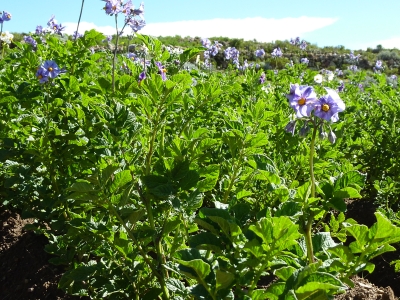
Wild flowers on the isle

ceremonial table in the Inca ruins

dung beetles in action
That evening from our hostel balcony we were treated to some of the most spectacular sunset views I have seen anywhere in the world – hopefully the many photos that Laura took will in some way do justice.

the sunset begins...

the sun dips

Laur checks out the colours

the sky is aflame

those colours again
Crossing the border - 10th February 2011
Today we took off early in a luxury bus to make the border crossing into Bolivia. We got a bit of a shock as the driver emphasised how important it was to produce the tourist entry card which we’d filled in on the plane arriving into Peru – I’d kept this but Laura hadn’t. Fortunately, and perhaps predictably you could pay to overcome this problem, and Laura lucked out as the official in charge of people who’d lost their landing cards was incredibly nice, going out of his way to help her queue-jump so we could be on our way.
The Bolivian side of the Lake immediately felt different (although this may have been in our minds), more peaceful and scenic. Our first stop was Copacabana, prompting some predictable Barry Manilow comments from me. The town itself was small and comfortably geared up for backpackers, who were there in abundance wearing Llama colourful clothing and listening to Bob Marley in ethnic-themed cafes – the lingua franca of water-oriented tourism.

A station of the cross - one of 14

the dolores (pains) of Christ
We settled into a nice hostel with friendly, chatty staff who helped us along with our Spanish, then went for a wander up the hill overlooking the town, featuring 14 stations of the cross - large cruxifixes with dedications on them periodically set on a winding path up a steep (naturally) hill. At the top were further monuments depicting crucial stages in the crucifixion story, and a great view over the bay.

illicit photo of the inside of Copa Cathedral

Cholita vendors outside the Cathedral
More Candeleria - 9th Feb 2011
A less hectic day of Candeleria celebrations greeted us in Puno today; we spent the morning wandering up to the massive Inca statue at the top of the town, with great views around the bay of Lake Titicaca that puno is situated in , then caught a great procession featuring people in traditional dress and playing traditional instruments like massive pan-pipes that stretched down to the ground, a welcome change from the now ubiquitious and constant brass bands. There were even a couple of gringos in the traditional bands, which all were attached to cultural clubs – we were stationed outside the main church, and interestingly some of the bands stopped and bowed in front of this while others – notably made up of Quechan/indigenous people didn’t.

Dancers posing for us in Puno

Long pan pipes

The Virgen makes an appearance

and makes her way down the street

A face in the crowd
After lunch we headed down to the port and onto our local boat for the tour to the floating Islands of Uros. A really cool concept, where villagers actually lived on floating islands constructed from the reeds which were abundant in that part of the lake, constructing boats, buildings, bridges and lookout towers as well as “solid” ground out of the reeds.


Laur on the way to the floating reed islands

boats and the reed islands
Unfortunately it had degenerated into a bit of a tourist trap and felt quite inauthentic – Laura even heard rumours that people from the mainland would come over and pretend to be floating island villagers for the day, then head back once the tours were over, and I believed this. They’d even hung out fake washing to make it look inhabited! The engine on the public boat we were on kept breaking down, but it was still a nice jaunt and the lake looked lovely

Gathering the reeds

Safe cooking on the reed islands
Tuesday, 8 February 2011
Celebrating Candeleria - 8th Feb 2011
Now almost completely out of clean clothes and craving the simple things in life – wireless, a working kitchen etc – we tapped up the Thorn Tree for some recommendations to change our hotel. As usual it came through and we relocated to a gringo-friendly place near the centre of the Candelmas action – as I type this we can hear bands, singing and fireworks and it’s set to continue for the next few days. We spent the afternoon getting to know Puno while there was a lull in proceedings, and wandered down to the shores of lake Titicaca where we saw pink flamingos and oxen wading through swampland to get at the fresh grass.
It’s nice to be with friendly gringos and to have a conversation in English, and we chatted to a guy from Melbourne who has been living in an obscure Chinese town in Szechuan province for the past 9 years, and had picked up some of the Chinese way of phrasing things. Tomorrow we’re hoping to do a tour of the floating reed islands on Lake Titicaca before we head for the Bolivian border; now it’s time to chill a bit and update our friends and family on where we are.
Subscribe to:
Posts (Atom)